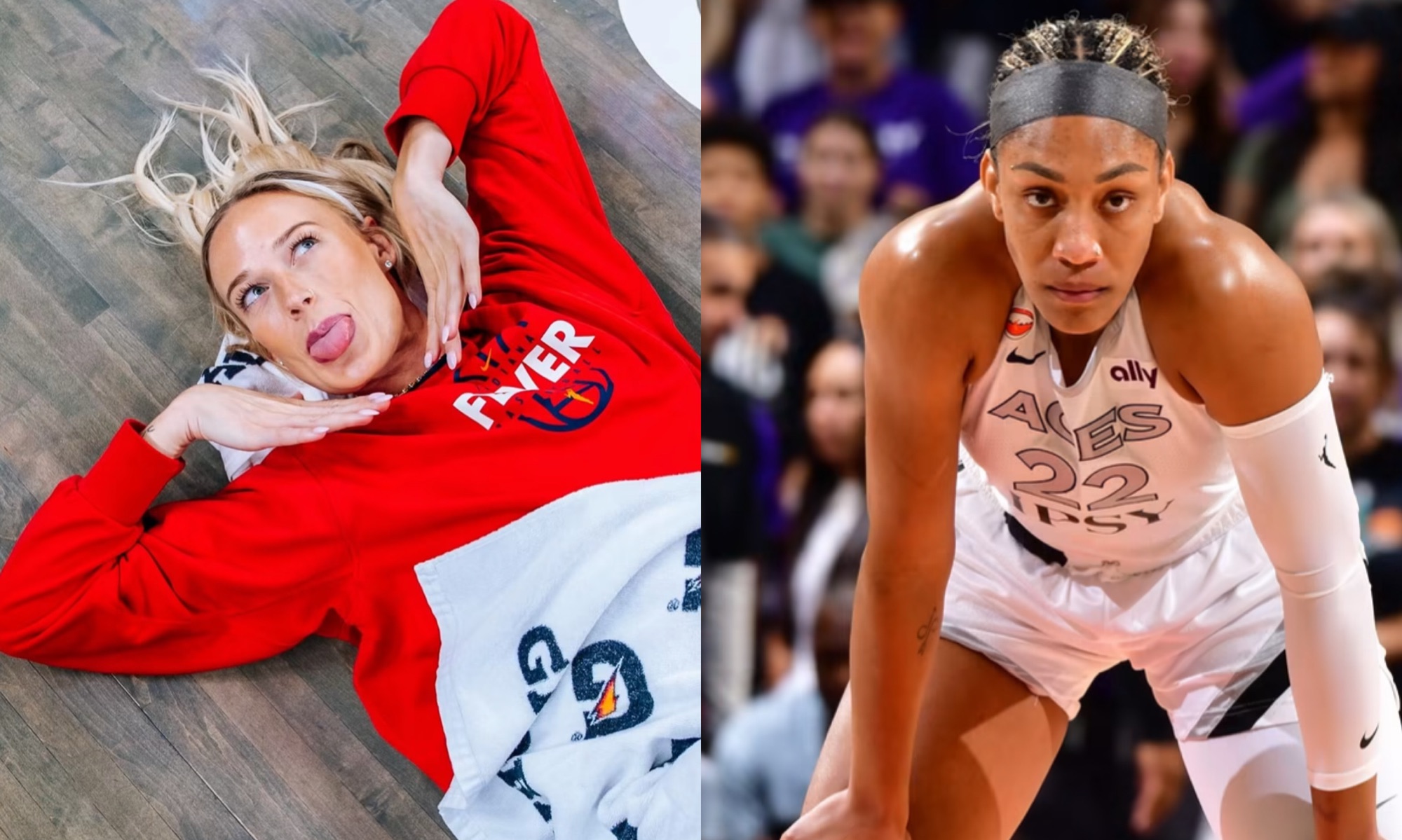
Indiana Fever guard Sophie Cunningham expected to be celebrating when she sat down to record her podcast. Instead, she spent the episode picking apart the Fever’s playoff loss to the Las Vegas Aces and telling anyone upset over a fan’s courtside gesture toward A’ja Wilson to “grow up.”
“But I think for someone pointing and saying that the foul is on you, like grow up. I’m over it,” Cunningham said on the latest episode of “No Hesitation,” the podcast she hosts with her trainer, NBA skills coach Drew Hanlen.
The defending champion Aces eliminated Indiana in the first round, winning two of three games and closing out the series by beating the Fever by 11 points in Game 3 in Las Vegas.
“So I thought we were going to be on here celebrating,” Hanlen said.
“Dude, I did too,” Cunningham said. “Seriously, I believed it. I truly believed it.”
Cunningham said the series mirrored an inconsistent season.
“I think as a season overall, we are very inconsistent,” she said. “I think we hit maybe our peak in July, and the FIBA break kind of hurt us a little bit. But I think this series kind of was our season in a nutshell. We had a horrible first game. We came out very flatfooted, not aggressive, gave too much space to the guards, didn’t even touch A’ja, which is just unacceptable.”
The Fever responded with a win at home in Game 2.
“Second game, I think we really brought the energy. We brought the dog. Our backs were against the wall,” Cunningham said. “And this might sound crazy, but I think the second game and third game, we finally played as a unit because it didn’t matter who got the credit. We just had to get the dub.”
She said Indiana started strong in Game 3 and weathered some early storms before the game slipped away.
“Some tough calls down the stretch by the refs, some very questionable calls by the refs, truly,” Cunningham said. “And then just at the end, we just didn’t have enough. They’re three time world champs for a reason. And good luck to them moving forward.”
Hanlen pointed to numbers showing how much seeding matters in the WNBA postseason: 75% of series are won by the higher seed, and 64% of home games are won by the home team.
Cunningham said the Fever’s uneven regular season cost them that edge.
“I think we shot ourselves in the foot throughout the season of just not being consistent and kind of continuing to be on that roller coaster,” she said. “At the end of the day, you got to show up and you’ve got to win because you have to put yourself in the best playoff position. And if we would have got home court advantage, maybe we would still be playing right now.”
She said the crowd at Gainbridge Fieldhouse for Game 2 was the loudest she had heard.
“That second game, it was crazy. It was loud. It was loud loud,” Cunningham said. “There’s something different about playoff basketball and them showing up and showing out for us. We finally have fans that are coming out to support us women. And look at us trying to scare them all away yet again.”
Wilson, the reigning MVP, had 38 points and 16 rebounds in the series opener in Las Vegas, many of them on uncontested looks. Cunningham scored 13 points and went 3 for 6 from beyond the arc in the loss.
“It’s too soft,” Cunningham said of the defense on Wilson. “If you watch her warmups, she literally has like a dummy defender and she’s just working on a jab shot. And that’s exactly what we were allowing her to do in the game.”
Cunningham, who has faced Wilson since college, said the answer is physicality.
“I think you have to make her work. She is the MVP for a reason,” she said. “I’ve played her since my college years. Force her right. She wants to go left, and you got to send a double. When she starts spinning, you need to get her off the ball.”
“Having an arm distance is not enough,” she added. “You got to be body to body with her. You got to make her put it on the ground more than once.”
As Hanlen rolled the film, Cunningham kept returning to the same point.
“It’s always just arm’s length,” she said. “It’s got to be body to body. You got to be on her hip, d*** near, like physically. And I think when we did that, it worked.”
“Star players, you don’t want to get them going,” Hanlen said.
Cunningham said the problems started on the perimeter.
“Honestly, I think it starts with the guards. We were too soft with their guards,” she said. “There wasn’t enough ball pressure, so Chelsea Gray, Jackie Young, they were able to just kind of throw the ball wherever and getting wide open shots, and that’s just unacceptable.”
She also questioned why Indiana guarded Las Vegas’ nonshooting bigs so far from the basket.
“Why are we even guarding them at the three point line? Get in the paint, clog that thing up,” Cunningham said. “They don’t call defensive three, they don’t call offensive three. So if you’re just going to sit in the paint, then why don’t we do that same thing? And that’s exactly what Vegas does.”
Hanlen said the opening loss was especially costly because first round series in the WNBA are only three games.
“In a three game series, you can’t just give up a game,” he said.
He used the moment to pitch a change.
“One of the hopes for me for the next commissioner would be make this first series five,” Hanlen said. “At least give me five, because then it does allow you to kind of feel each other out. It does allow you to make adjustments. A five game series gives you more of a chance to kind of make adjustments and ultimately see which team’s better instead of just which team kind of got the first jump.”
“Drew, you sound very intelligent. Maybe you should go for the gig,” Cunningham said.
“Not happening,” Hanlen said. “I am not throwing my name in that hat.”
Cunningham said the team’s film session after returning from Las Vegas set the tone for Game 2.
“We came in the next day after we got home from Vegas and we watched the whole game, and we were all just sick. We played horrible. That was just unacceptable,” she said. “Hopefully when people watch this game, you see that no one’s getting easy touches, that we are physically bumping people and annoying them. That stuff gets old, seriously, and it gets in people’s heads.”
Indiana picked up full court to force Las Vegas to start its offense with 13 or 14 seconds on the shot clock instead of 20, sent double teams at Wilson and switched aggressively on screens.
“Our biggest message to each other is like scramble,” Cunningham said. “Whatever we do, do it hard. Have each other’s backs.”
“We got some turnovers. Our foul discipline still s*cked. We got to get better at that next year,” she said. “But I will say that I was proud of the dog that we brought to Game 2.”
Hanlen called it one of the Fever’s best defensive performances of the year, noting that forcing Las Vegas into one on one play “usually yields some of the lowest points per possession.”
“I honestly thought that Game 2 was one of your guys’ better defensive efforts,” he said.
Cunningham said the difference was intent.
“Aggressive switches, because in Game 1 we were trying to switch some, but it was soft and our hands were down and we weren’t affecting the ball handler at all,” she said. “You just can’t do that against this team.”
On offense, Indiana scored 58 points in the paint. Caitlin Clark had 25 points and 15 assists, which Hanlen said made her the first player in WNBA history to reach those numbers in a playoff game.
Cunningham, referring to Clark by her nickname, CC, said the guard set the pace.
“She was not settling. She was pushing it,” Cunningham said. “When CC is getting other people involved, she’s unstoppable because the defenders do not know how to guard her. Are they all going to send two to her? That leaves two people wide open, and she’s going to make that willing pass. She really led the pace and aggression on offense in Game 2, so I want to give her her flowers on that.”
She said having Clark and Kelsey Mitchell on the floor gives the Fever a chance in any game.
“It does not matter the score. When you have 100% CC and you do have Kelsey, you’re never out of a ball game,” Cunningham said. “You always feel confident. You always have that belief that we could win this game. And we felt that in Game 3, too. I’m not even going to lie to you.”
“That’s her first time playing at Gainbridge during playoffs, and so I think she made a pretty big statement,” Cunningham added. “So yeah, I’m proud of her. Was bada**.”
Hanlen highlighted how often high ball screens set near midcourt produced layups for Indiana and said he expected the Fever to keep running them in Game 3. Cunningham said a recurring problem all season was abandoning what worked.
“Something that we have struggled with a lot this year, and we’ve done so many great things, so I don’t want to sound like I’m harping on the negative,” she said. “One of them was on offense, when stuff was working, it’s like we got bored of doing it, so we tried other stuff. And I’m like, why? Why?”
“I don’t know if that’s on our point guards. I don’t know if that’s on our staff, if that’s on us not calling what’s working,” Cunningham said. “This has happened pretty much every single game, that when stuff goes well and we’re scoring and we’re hitting all the options, we just randomly stop doing it, and that’s when we kind of tend to lose leads. I think it’s mind blowing. I don’t understand it.”
“Spam it,” Hanlen said. “I am under the kind of impression of just keep running it until they do make the adjustment.”
The episode’s most pointed moment came when Hanlen raised a Game 2 incident in which a courtside fan at Gainbridge Fieldhouse pointed at Wilson and told her a foul was on her, drawing a reaction from the Las Vegas star. Hanlen played a clip from “The Pat McAfee Show,” where a member of McAfee’s crew had been seated next to the fan.
“I have so many thoughts, and I almost put it on Twitter today flying back, but I saved it for the pod,” Cunningham said. “Us women in sport, I’m going to say just women in sport because that’s my occupation and I have lived this. We yell from the rooftops that we want equality, that we want to be treated like the men, that we want all this stuff and we deserve all these things. And we do. We do deserve it.”
“But if you’re asking for all these fans to come and you have new fans who are real sports fans, and they come and do something that a sports fan would probably do if you’re on the opposing team, and then we’re going to go for them for just pointing, saying that you fouled? Like, grow up. What are we doing?” she said. “We ask all these things, and then once people come out and support us, we get mad and it’s inappropriate.”
Cunningham said she has endured far worse from critics.
“I can say this because I hands down have probably got the entire season, maybe sometimes two seasons, of people coming after who I am, my character, what I stand for,” she said. “I’ve heard the worst of the worst. It’s part of it. Who cares? You should be grateful to be on this platform. You should be grateful to be playing basketball for a living and inspiring the next generation.”
“If you really want sports fans, then you’re going to get sports fans. And that includes pointing. That includes getting yelled at, probably getting called names,” she said. “With all the praise and all the great things that come with it, you also got to look at the negative side.”
“I’m not saying that this guy did anything wrong,” Cunningham added. “I don’t think he did absolutely anything wrong.”
She suggested Wilson’s reaction could have drawn a suspension.
“If you want to get technical, that could have caused for a suspension, but she’s like the LeBron James of our league, and so of course they’re not going to suspend her,” Cunningham said. “Something should have happened there. The two people who came off the bench onto the court, that should have happened. I think there’s definitely a double standard.”
Cunningham said she was glad Wilson played in Game 3.
“I think we wanted her to play. I think that makes for good basketball,” she said. “If we would have won and she wouldn’t have been there, I don’t think it would have been fair. I think we would have gotten a lot of backlash from that.”
She also responded to criticism of a TikTok video she posted about the incident.
“Who would have thought someone pointing would just cause so many people to go into a mental spiral?” Cunningham said. “That says a lot more about you and your mental status than anything that the fans are doing. So I’m over it.”
“I asked if you had any thoughts,” Hanlen said. “I didn’t know I was going to get a whole journal entry.”
Hanlen then showed a separate clip from the series in which a fan appeared to step toward the court and point at Fever players, who did not react.
“Drew, who gives a [expletive]? Who literally cares? No one should care about this,” Cunningham said.
She said the more important part of that play was a foul called on Fever guard Lexie Hull after, in Cunningham’s view, Aces forward Brianna Turner hooked her.
“Lexie was playing great defense, and Brianna Turner actually came and hooked her and lowkey did like a WWE move, and it could have been dangerous,” Cunningham said. “Her shoulder legit could have popped out. If you watch the clip, it’s a dangerous play.”
Cunningham sarcastically suggested the Fever start making a bigger deal of how opposing fans behave.
“I guess we should start causing more of a reaction to how other people come into Gainbridge and try to call our fans all these names, all this trash,” she said. “No, we have great fans and we’re proud to represent them. They represent us. We just know how to handle ourselves. So good job us, Fever girls.”
Cunningham said Fever coach Stephanie White called a timeout to challenge the call and was given a technical foul for coming onto the court.
“One of the refs, Tim, I said, ‘Tim, why can’t we challenge that?’ And he goes, ‘I don’t know the rules,'” Cunningham said. “What? You’re a ref in playoffs and you don’t know the rules? That’s just one of the instances that, that’s a bad call, and that matters because that was Lexie’s second or third foul, and she’s a guard that plays a lot for us.”
“You’re really getting the real me tonight, Drew,” she added. “This is fun.”
“This is like part film breakdown, part therapy,” Hanlen said.
Cunningham said the Fever felt good after Game 2 but knew they had more to give.
“I think we as a whole, we felt good, but we knew it wasn’t enough,” she said. “We knew we got the win, but there was more in our tanks.”
The message was to carry over the communication on screens and the full court pressure. Instead, she said, the details slipped.
“I think that there was some slippage in Game 3 there, that it wasn’t where it needed to be, which ultimately hurt us,” Cunningham said. “Our pace was good, but it wasn’t consistent enough. It was kind of the inconsistency of our season, and you kind of saw it in Game 3.”
“There is going to be times where they go on runs, but you have to weather it,” she said. “Our biggest thing was we got to control the empty possessions. If we go one, two, hopefully not three, but three trips down without a score, that fourth one, we got to dial in and freaking get a bucket.”
Hanlen’s film review counted roughly 26 points Indiana gave up on mental mistakes: 11 on miscommunication defending ball screens, about seven in transition and eight on face cuts and missed help.
On one play, Cunningham explained that the Fever were supposed to trap ball screens, but the coverage broke down and left Jewell Loyd open for a shot from deep.
“This is the difference between Game 2 and Game 3. One of the adjustments we made is we’re supposed to be reading here, and reading means trapping the ball screens,” she said. “That’s slippage there. And that’s the little details that we all messed up on as a whole. Just the minor details, which seem minor, but in these types of games, they truly do add up. We weren’t on our p’s and q’s early in the game.”
She also credited Las Vegas guard Jackie Young.
“Jackie is a h*** of a player. She’s phenomenal, man,” Cunningham said. “And A’ja is too. She gets a lot of credit, but Jackie deserves her flowers as well.”
Cunningham said the mistakes reflected a lack of playoff experience.
“This is where playoff experience matters because people realize that these small details, you can’t get it back. You can’t get it back,” she said. “The experienced teams and the teams that have won at a high level, they understand that and they don’t take those little moments for granted.”
“If anything that we maybe learned from Game 3, we all gained more playoff experience, which is amazing,” she said. “But still it s*cks watching it, because those are such dumb, easy mistakes that are so in our control.”
Hanlen said the high ball screens that worked in Game 2 worked again in Game 3 when Indiana went back to them, which left him wondering why the Fever did not run them more.
“Why did you not call me? D*** it,” Hanlen joked. “I thought you guys were going to stick with the same recipe that worked in Game 2.”
Cunningham pointed to the Fever’s pace when the offense was clicking.
“Look at our pace. People are cutting hard from the get go,” she said. “We had really good stints of it, but our pace started to slow down. And I think our pace matters, especially for a young buck team who likes to run and gun, who likes to get downhill.”
“We had way too many empty possessions,” Cunningham said. “The possession game matters. It matters in regular season. It definitely matters here in playoffs. And it definitely matters when you’re on the road playing the three time defending world champs. We got to be better, and we just weren’t.”
She said a missed call with two to three minutes left changed the game. Indiana challenged what it believed was a foul on Mitchell under the basket and lost the challenge.
“If we would have got that challenge, which we should have, that was definitely a foul. We should have gotten it, and I’m not just saying that. Everyone knows that,” Cunningham said. “If we would have got that, we’re in the ball game, right? But then not getting that, that gave them two more points. So that’s four. And then a ticky tack foul, the A’ja whistle. So that gets them up six points, and then you’re just scr*wed from there. They’re just too good. You just can’t really come back from that.”
Hanlen noted that Indiana had the highest foul rate of the eight playoff teams, while Las Vegas had the lowest. He also offered what he called two things Cunningham could not say without risking a fine from the league.
According to Hanlen, the Aces finished the series with a plus 31 free throw differential, the largest ever in a three game WNBA series. Las Vegas led by just two points with 2:15 left in Game 3, then scored 12 of the final 15 points, 10 of them at the line, where the Aces went 10 for 10.
“I will say that you guys do hack, so I’m not forgiving you guys for that,” Hanlen said. “But for Fever fans that were mad at the refs, there are some stats that are on your side in that category.”
“You are going to make me be more professional here,” Cunningham said. “And so I’m going to let you say things that I can’t.”
Hanlen said Las Vegas also looked calmer late, going away from Wilson and handing the ball to Chelsea Gray to close the game.
“It wasn’t a lack of trying. It was just more of almost over trying instead of just allowing things to happen,” Hanlen said.
“Just trusting it and executing down the stretch,” Cunningham said.
Despite the early exit, Indiana set a franchise record with 28 wins, had the league’s top ranked offense and averaged 96 points per game, a WNBA record, according to Hanlen. The Fever won 10 of 12 games during one stretch in July and August.
“We were so good, and it was so much fun. And the squad really loved each other,” Cunningham said. “I think FIBA kind of hurt our momentum a little bit. Maybe we peaked too soon. I don’t even know if that’s a real thing.”
“We really did have a h*** of a year, and I had so much fun,” she said. “Kelsey had a great year. Caitlin had a phenomenal year. AB, of course, always does AB things. But we do have a lot to be proud about. It s*cks because we’re all just so competitive and we just want a championship at the end of it. None of this really matters, all these fun historic in season stats, because everyone just wants to win.”
Several Fever players, including Cunningham, are headed for free agency.
“I don’t know what the offseason holds. A lot of us are under free agency now, and so who knows,” she said. “But looking back, I think one day when we look back at this season, we’re going to be proud of what we did in the months of July and August.”
Mitchell averaged 24.7 points, second in the league, and broke Wilson’s record for total points in a season while also setting the mark for most shots made from beyond the arc in a season, Hanlen said. Clark averaged 22.3 points, a career best and third in the league, and was named AP Comeback Player of the Year. Aliyah Boston averaged 16.1 points, also a career high.
Cunningham ranked fourth in the WNBA at 41.9% from beyond the arc while averaging 5.3 shots per game during the regular season. In the playoffs, she averaged 7.3 points on 4.7 shots and made 44.4% of her attempts from deep.
Hanlen said that efficiency often gets lost amid criticism of Cunningham’s outspokenness.
“I know that there’s a lot of haters online that don’t like that you’re very vocal, and they think that you should just stick to basketball,” he said. “I always think criticism is fair, but you also got to compliment that you are super efficient.”
“I’m still annoyed. I’m annoyed by my three point percentage, though. That should have been higher,” Cunningham said. “I just listen to all the people that love me. So maybe that’s why I’m delusional. I don’t know. But I love it.”
“Listen, that’s a way better route to go,” Hanlen said.
Cunningham said she will take a few weeks off before resuming training in November ahead of her first season in Project B, a new league that opens training camp in December and begins play in January.
“I think I’ll take probably a couple weeks off here and enjoy October, and then start getting after it November, because I’m in good shape,” she said. “I feel really good. I feel very healthy. I’m liking where my game is at. It’s a good baseline, but I’m ready to improve and really work on my skill set.”
Project B is played tournament style in five countries, with stops in Asia and Europe, from January until WNBA training camps open. Each stop lasts up to 10 days.
“You’re only there for 10 days max. They take great care of you. First class, everything. Staying in the nicest hotels,” Cunningham said. “Kind of getting to globally expand my brand, which is going to be super cool. But I’m still able to come back here and make my money and enjoy the offseason as well.”
Cunningham previously played in Australia and France before giving up overseas basketball.
“It just wasn’t for me. I was making more money back here at home with my partnerships, endorsements, and I actually started doing media. I loved it,” she said. “I was calling Suns games. I feel like my IQ got even higher, and I fell even more in love with basketball.”
She spent last offseason rehabbing a knee injury in Phoenix.
“I’m a snowbird,” she said. “I cannot do the cold anymore.”
Cunningham credited pickup games in Arizona for her recent shooting.
“The last two offseasons, I have a great group of guys who we do pickup runs probably four days a week out in Arizona, and I have loved it,” she said. “It has expanded my game, how quick I can get my shot off, my defensive skills. It really does improve.”
Hanlen laid out the numbers behind their offseason plan. Cunningham shot 70% in the restricted area but attempted only 47 shots there all season. She made 43.4% of her catch and shoot jumpers, in the 91st percentile, and 37% off the dribble, but on just 7 of 19 attempts. In the paint outside the restricted area, she went 4 for 19.
“If you really want to expand your game and become more versatile on the offensive end, you got to get better at putting the ball on the floor, being able to drive closeouts, being able to finish those when you do get downhill and get in the paint, and then also just maybe add a little tween game,” Hanlen said.
He said improving defensively would keep her on the floor.
“If you’re one of the best shooters and you become a plus defender instead of an average defender, then the coach is like, ‘I need them out on the court,'” Hanlen said. “You’ve mastered the catch and shoot spacing. But then adding more versatility on offense by putting the ball on the floor, and then also defensively becoming a plus defender instead of an average defender, I think takes you to a new level.”
Cunningham said she welcomes that kind of critique.
“I love it, because I’m like, it exposes where I need to grow, and it exposes where I can grow. That type of stuff right there excites me,” she said. “Even on the catch and shoot jumpers, 91st percentile, OK, cool. I still feel like I can get even better at that.”
“I still just love basketball. I still have that fire inside of me. I still think my best days are ahead of me,” Cunningham said. “I don’t even know who ever said that I was a three and D player. Someone else gave me that. I never did in college. I had that post up game, and I had the jumper.”
“When you get to the league, sometimes you do just have to find something that you can be excellent at, and you got to become great at it so people know that you’re a weapon and they’re able to use you,” she said. “But I do feel like there’s more in my tank.”
Hanlen said his real coaching is less analytical.
“In real life, I’d be like, ‘Hey, Sophie, you know that it’s OK to dribble the basketball. You don’t have to be allergic to dribbling the ball and putting the ball on the floor,'” he said. “Three and D is a lot better than Trey and Prey.”
“She definitely chirps back,” Hanlen added.
Cunningham said she is ready for the work.
“I think it’s going to be challenging both physically and mentally, but I’m here for it. This is what it is to be a pro, and I’m excited that I actually have a great trainer that’s going to help me raise my game to the next level,” she said. “So it’s about to be bada**.”