
The trailer is out for “NAZA,” a new documentary from two of the directors of the Academy Award winning “No Other Land” that draws on secret nighttime conversations with Israeli military intelligence officers and soldiers who, the filmmakers say, designed and operated the systems behind the mass killing of Palestinian civilians in Gaza.
The film, directed by Yuval Abraham and Rachel Szor, opens in New York on Sept. 30 and in Los Angeles and select cities on Oct. 9. The Guardian is one of the film’s producers.
The title comes from a Hebrew military acronym for “collateral damage,” which the directors say Israeli intelligence uses to indicate the number of civilians it expects will be killed in an airstrike.
In a statement, the directors said the film grew out of their sense of duty as Israeli journalists.
“We made this film out of a sense of obligation to use our position as Israeli filmmakers and journalists to examine the systems behind the mass killing of Palestinian civilians for which our country is responsible,” they said. “While filming members of Israel’s military on rooftops at night in Tel Aviv over the past three years, we found ourselves asking the very questions that were asked by our grandparents’ generation and throughout the 20th century: how does one group of people allow the total dehumanisation of another? What do the inner workings of such a system look like?”
“Many of the revelations in the film were published almost immediately as we learned of them, in the months following the October 7th attacks, by The Guardian (one of NAZA’s producers), in collaboration with reporting partners +972 Magazine and Local Call,” the statement said. “The film lets us explore something deeper than we could in our investigative journalism alone: not only the words being said but also those that are not said, the silence. It is up to all of us to break that silence.”
In an interview with The Guardian, the directors said the film focuses on systems rather than individual misconduct. They said they gathered testimony from two dozen intelligence officers and soldiers to depict the military systems used to carry out what they said a U.N. commission and leading human rights groups have described as a genocide.
“Our focus is therefore not on sporadic war crimes committed by rogue soldiers who disobeyed orders. It is on the orders themselves, the policies, the accepted practices, the language and logic that make those practices possible, and the people who operate within them. The system and its cogs,” they said.
“This matters in part because the question of genocide is inseparable from the question of intent,” they added. “Intent is often treated as something hidden in the minds of political or military leaders. But systems also reveal intent: through the rules they create, the targets they authorize, the risks they accept, and the patterns they repeatedly produce.”
The directors said they decided to make the film in late 2023, after the Hamas attack on Oct. 7, when they watched “our country’s leadership, with the support of mainstream Israeli media and large segments of the public, normalized genocidal ideas about Gaza’s population: that there are no innocent civilians living there, only ‘human animals’ unworthy of life.”
“The film shows, we believe, that the slaughter of civilians in Gaza was not simply a byproduct of war, as it was often framed by media outlets, but a premeditated, calculated and intentional action, stemming directly from Israeli decisions,” they said.
Beginning in late 2023, Abraham wrote investigative reports on the Israeli military’s targeting systems powered by artificial intelligence and on plans for forced population transfer in Gaza. The reports were published by Local Call and +972 Magazine, often in partnership with The Guardian. The New York Times and The Washington Post later reported on and confirmed the existence of the same systems, according to the directors.
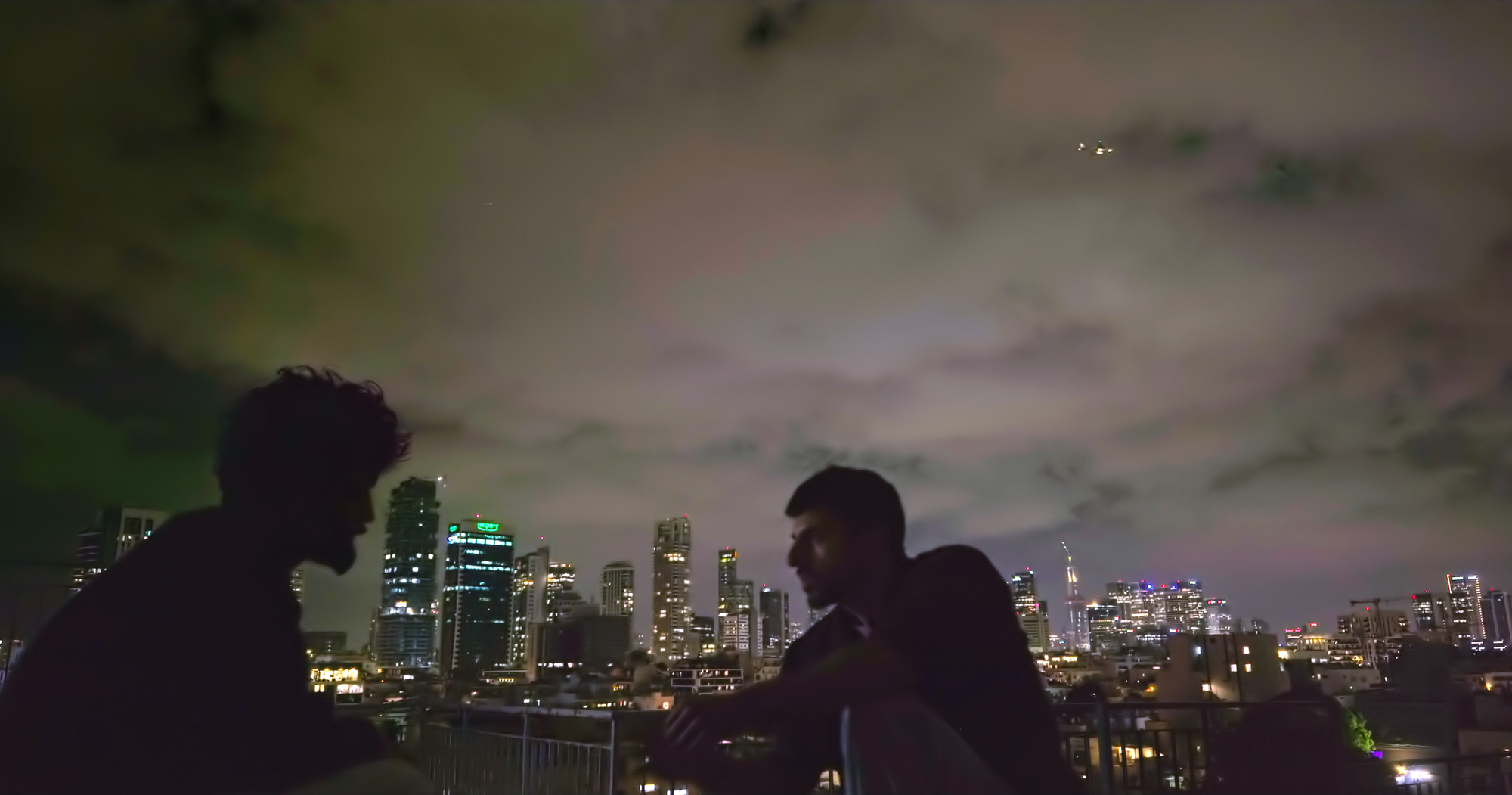
The film contrasts Tel Aviv, which the directors called Israel’s liberal hub, with Gaza, about 44 miles (60 kilometers) away.
“Gaza is present through its absence,” they said. “This form allows us to depict violence indirectly, in the hope that it might break through the numbness and inaction of too many people who are already used to the many direct images of violence.”
The directors said they were influenced by executive producer Jonathan Glazer, who said of his film “The Zone of Interest” that its victims may be out of sight but are “never out of mind.”
All interviews were filmed on rooftops at night. “It felt like the only option for the film,” the directors said, adding that since Oct. 7, “we have been engulfed in total darkness and dawn is nowhere in sight.”
“Darkness is seen as an enabler of crimes, actions that need to be kept secret because of their atrocious nature. But darkness is also an enabler of honesty, people say things when it’s dark they would not have said when it’s bright, and some of the most intense, revealing moments of the film happen when the lights are out,” they said. “Without honesty about what happened in the dark we won’t be able to move into the light again.”
Interviewees illustrate their accounts with diagrams drawn by hand with pen on paper.
“By asking these soldiers to draw by hand the systems they used, we felt we would not only be gaining important insight into how they worked, but also insight into the way individuals involved in remote mass killing view and represent their victims, insight into the gaze of the perpetrator,” the directors said.
The camera also turns to everyday life in Tel Aviv, where Israel’s main military headquarters is located and where many people leading the bombing campaign in intelligence units come from, according to the directors.
“The film is a testament to the role they played, a reminder that to commit an atrocity of such scale, all parts of society need to take part,” they said.
The 24 interviewees, all Israeli military intelligence officers and soldiers, spoke on condition of anonymity. Their appearances and voices were digitally altered. The directors said all had been involved in the surveillance or remote killing of Palestinian civilians in Gaza.
“It was clear that the officers would not speak otherwise, fearing retaliation from the Israeli state for doing so,” they said.
Asked why the sources agreed to talk, the directors said, “Almost all of the Israeli media has been so uninterested in the civilian consequences of Israel’s bombing of Gaza that a vacuum has been created, into which it was possible to enter. Sometimes, all it took was asking the right questions.”
Some sources spoke out of shame or guilt, while others were motivated by pride in their expertise, the directors said. The film intentionally does not dwell on those motivations.
“To spend too much time on the sources’ motivations for speaking, their remorse, their pride, their political opinions, would risk shifting the centre of gravity away from the victims, which is something we did not want to do,” they said.
Finding sources took years because they serve in the country’s most secretive intelligence units, according to the directors.
“Militaries are built around a decentralization of duty: each officer is responsible for a part of the kill chain, while the full consequences of an operation are often dispersed across many different people, units and decisions,” they said.
Unlike “No Other Land,” which Abraham and Szor directed with Palestinian filmmakers Basel Adra and Hamdan Ballal, “NAZA” was made by the Israeli team alone.
“If our Palestinian colleagues tried to call up intelligence officers, as we have done, they would likely be arrested and tortured or even murdered,” the directors said. They cited the Committee to Protect Journalists, which they said has documented more than 200 Palestinian journalists killed by Israel in Gaza since Oct. 7.
“But Israeli soldiers do not somehow possess a more truthful version of events than Palestinian victims,” they said. “It is precisely because we live in a world that so often refused to believe the victims and minimized their testimonies, that we felt an urge to collect testimony from inside the system that was attacking them.”
The directors said framing civilian deaths as collateral obscures their deliberate nature, a danger they said grows when artificial intelligence can generate endless military justifications.
“This turns a cornerstone of international law, the obligation to attack only military targets, into a tool that legitimizes the slaughter it was intended to prevent,” they said.
They pointed to a leaked recording of Aharon Haliva, a former Israeli military intelligence chief, who said: “For everything that happened on October 7, for every one of us who died on October 7, 50 Palestinians must die. It doesn’t matter now, children or not. I’m not speaking out of revenge but as a message for future generations. They need a Nakba now and then to feel the price.”
“We think that one way the Israeli military was able to bring a genocidal vision like Haliva’s into military practice, while obscuring its nature, was by defining much of the killing as ‘collateral’, or ‘NAZA’,” the directors said.
The film builds on reporting by Abraham and Harry Davies, a Guardian investigations correspondent and one of the film’s producers. Since 2023, their work has included investigations into Israel’s targeting practices driven by artificial intelligence, a 2024 project on Israel’s efforts to undermine war crimes investigations and a 2025 investigation into a surveillance system built with Microsoft technology that captures millions of Palestinian phone calls each day.
“While our reporting has offered a glimpse of modern warfare, it has also revealed something more specific: how Israel’s expansive architecture of mass surveillance in the occupied Palestinian territories was instrumentalised in one of the most destructive aerial bombing campaigns in recent history,” Davies said. “A system built to listen and control helped create a machine of mass killing.”
“NAZA” is produced by Davies, Lindsay Poulton and James Wilson, with Glazer as executive producer. Glazer and Wilson’s “The Zone of Interest” won the Oscar for Best International Film in 2024.


3 comments
Start now generating extra home based cash by doing very easy and simple job from home. Last month i have earned $19753 from this job in my part time. This job is just awesome and its earning are greater than 9 to 5 office job. Join this right now by follow instructions here…
>>>>>>>>>>>>>>>>>>>> https://Www.Job40.Com
I am making a good salary from home $4580-$5240/week , which is amazing under a year ago I was jobless in a horrible economy. I thank God every day I was blessed with these instructions and now its my duty to pay it forward and share it with Everyone,
.
Here is I started_______ https://Www.NetPay1.Com
❤️ World hot and horny girls are waiting for you join here ……………………………………………………………………………………………………..> https://da.gd/girls66